
A Rough Road that Shakes, Rattles and Rolls
Once we rented our car in Tamarindo, we knew it was only a matter of time before we headed out on a longer road trip. We had already enjoyed the nearby beaches and were looking for something a little different. We still had the condo for another week and a half at that point. For the amount we paid for the place we didn’t mind taking off for a few days and staying in a hotel to break things up. The choice was either south down the Nicoya Peninsula or east to Lake Arenal and the volcano. At the last second we chose south and let me say it was a wild few days.
We left in the morning with only a small overnight bag, some swim clothes and what we had on our backs. We were planning to be only gone that night and maybe the next. After travelling around so long with two big backpacks, 3 full day bags and one suitcase (stuffed mainly with toys and odds and ends we’ve picked up on the way) it was nice to be able to travel so lightly. The route down to the tip of the Nicoya Peninsula that we hastily decided on was supposedly paved the majority of the way with a little section that was gravel. We couldn’t find much info about that section except that the road was on the rough side. After seeing what passed for smooth in Costa Rica we weren’t looking forward to finding out how bad it really was. About 3 hours in we found out the hard way…
Up until that point, the trip was going quite smoothly. The roads were fairly quiet and the kids were enjoying seeing the country and being fed the 2 dozen different snacks we had prepacked. Jordan loves snacking and also loves variety so she was in heaven. Cole has always been an amazing traveler and he was up to fine form that morning. About half an hour before we got to the gravel roads we stopped in a small town to fill our tank. We were a little thirsty so we filled our bellies as well. One thing you quickly note while driving around Costa Rica is that unless you’re in San Jose or one of the larger centers, gas stations tend to be few and far between. With a bunch of unknown around us, we thought it prudent to be prepared.
Just past the ferry port of Playa Narango we finally reached that rough stretch of road. We knew it wasn’t paved but we were surprised at it’s quality. To be more precise, it’s lack of it. The majority of the road seemed to comprise of boulders ranging from marbles to golf balls in size; each with a jagged edge. Within a few kilometers we were quite thankful we had gotten the small 4×4 Bego SUV and not the car we had originally planned.
After another dozen or so kilometers we started questioning our route. With a definite lack of signage we were nervous that perhaps we had gotten off the main route and had accidently stumbled onto a smaller less traveled road. Sure enough we arrived at Bahia Gigante a short while later and knew we must be on the right track.
After 20 or so km’s we thought we were in trouble as we found ourselves driving over a very precarious and steep hill. Cole actually asked me if we were in danger. I guess the few expletives I let slip of the condition of the road made him question the logic of driving there. We made the climb (and rapid descent) of that hill and shortly after we arrived back on Costa Rica’s version of blacktop. Paved roads had never been so welcome. As we passed the ferry terminal just South of Paquera we realized most civilised people avoided the road and came across on the ferry from Puntarenas.
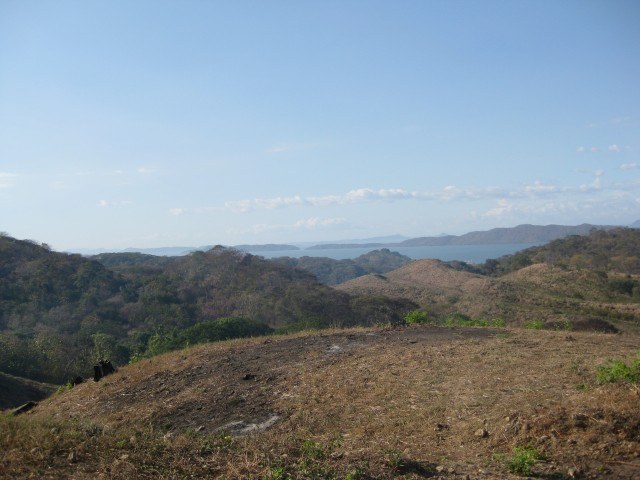
I have yet to drive on roads (that aren’t temporary or a rough detour) to match the jagged edges of that stretch. As such I would never recommend anyone buying a car from Costa Rica because there’s no way roads like that are good for a car’s shocks. On the plus side that little patch of Costa Rican highway led us closer to the tip of the Nicoyan Peninsula. It’s too bad the road is so rough because it took away from a lot of the amazing views that drive gave us. There were a lot of areas that were devoid of the normal tourist traps and swarms of sunburnt foreigners.
Along that route we got to see more jungle than we had seen before. Quiet inlets and untouched coves that spanned for miles. There was a stretch of road that was in “disrepair” (there was literally a large hole in the ground where the road should have been) that gave us a very scenic detour along pasture land and quiet country side. We saw small islands just offshore and one idyllic stretch of land and sea with nothing but horses there to enjoy it.
In retrospect, perhaps it was thanks to the rough roads that the area remains virginal. In either case there were some amazing ocean views and the drive from Naranjo to Paquera was something we’ll always remember. Cole might remember it better as the human shaker in the years to come but I’ll just think of it as the waker-upper to the quiet beaches and laid back vibes of the places to come. Namely Santa Lucia, Tambor and Montezuma which I’ll go into more detail on my next post.

 to get his take on life and travel while looking back at our own reasons for travel.
One Comment